
Why Lighting, Angles, and Facial Expressions Change Your Celebrity Match
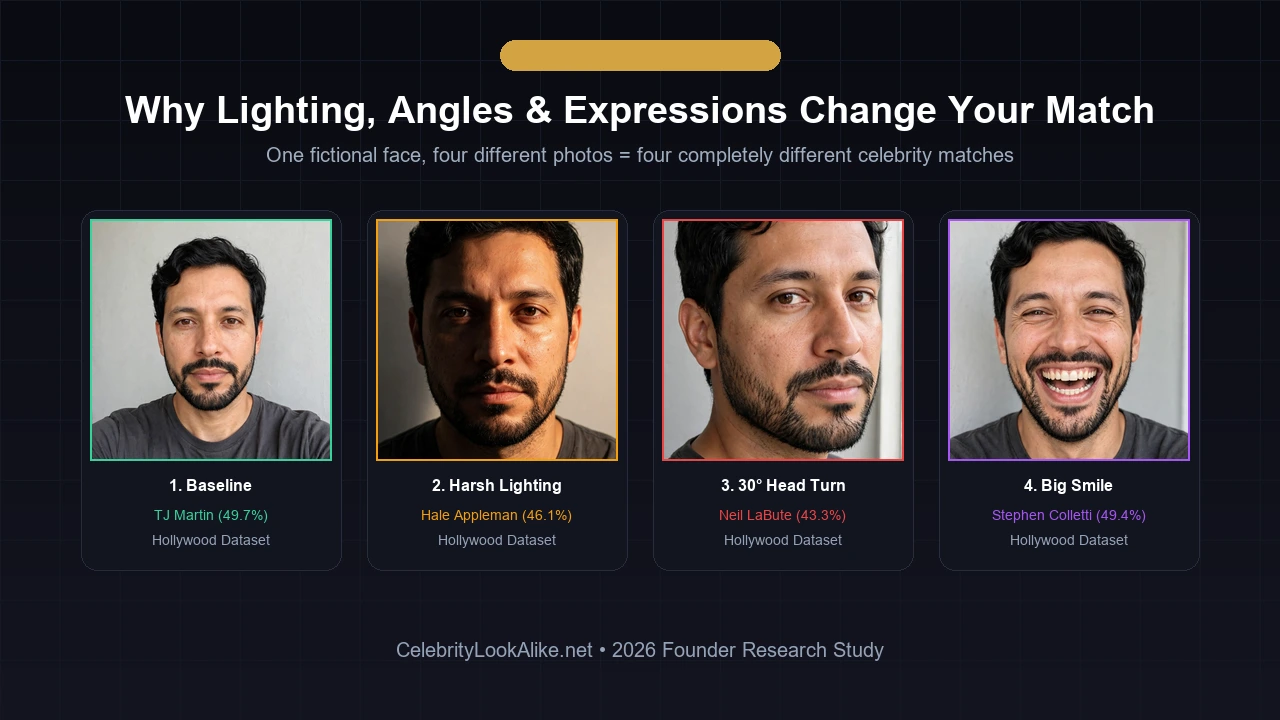
One fictional man, four different photos, and four completely different celebrity matches. Here is the exact visual evidence of what happened, why it happens, and how to get an honest result.
Welcome, friend! Let me tell you about the most humbling test I have run on our own tool this year.
I took one fictional man, photographed him four different ways, and uploaded all four photos to CelebrityLookAlike.net with the same face and the same filters, and I got four completely different celebrity matches. I will show you every screenshot below, because I would not have believed it either until I watched it happen live.
In the next five minutes, you will learn exactly why your lighting, your camera angle, and your expression change your celebrity match, and you will learn the simple photo formula that gives you the most honest result. There is no catch here and no technical lecture coming. Just plain English and real test results.
- 1.A quick honest note about the test photos
- 2.Wait, does the tool not just read bone structure?
- 3.The 4-photo test: how I ran it (baseline photo)
- 4.Why lighting changes your match (49.7% vs 46.1%)
- 5.Why angles change your match (the 30° turn that cost 6%)
- 6.Why facial expressions change your match (the smile surprise)
- 7.The one signal you can actually trust (the Steven Allerick rule)
- 8.How to take the perfect match photo (the 3-rule checklist)
- 9.Final thoughts, and your turn
A Quick Honest Note About the Test Photos
Before we dive in, full transparency. The four test portraits in this post are AI-generated images I created with Muse AI for this experiment. They show a fictional person, not a real user, and no real person's photo was used or stored at any point.
I generated them so I could change exactly one thing at a time (lighting, then angle, then expression) while keeping the same face, which is something you can never do cleanly with real selfies.
Wait, Does the Tool Not Just Read Bone Structure?
That is the exact question I asked myself before running this test, so let us answer it before we go further.
Yes, our tool studies your underlying bone structure. It maps hundreds of points across your eyes, nose, jawline, and cheekbones, and it compares that structural map against 3,500+ celebrity profiles. Bone structure is the anchor of every match.
But here is the part most people miss. The tool can only read the bone structure your photo actually shows it. Shadows redraw your edges. A turned head squishes your proportions. A big grin stretches your measurements.
The bone underneath never changed, but the photo handed the tool a different version of it. That is why two photos of the same person can point at two different celebrities, and my test proved it four times in a row.
The 4-Photo Test: How I Ran It
I wanted this test to be fair, so I locked down every variable except the one I was testing. All four uploads used the same settings: Male stars, Hollywood database, same fictional face. The only things that changed were lighting, angle, and expression.
Here is the baseline photo (soft natural daylight, face straight at the camera, relaxed neutral expression, camera at eye level) side-by-side with what our tool returned:

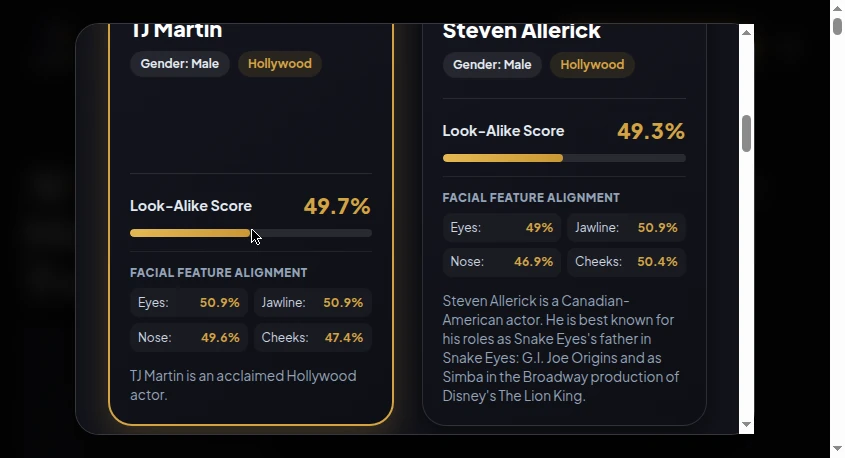
TJ Martin at 49.7%, with Steven Allerick right behind at 49.3%. That is our starting point. Now watch what happens when I change one thing at a time.
Why Lighting Changes Your Celebrity Match
For photo two, I kept everything identical except the lighting: same frontal pose, same neutral face, but now a strong warm lamp blasts in from one side, throwing deep shadows across half the face. Here is the photo alongside what happened to the match:
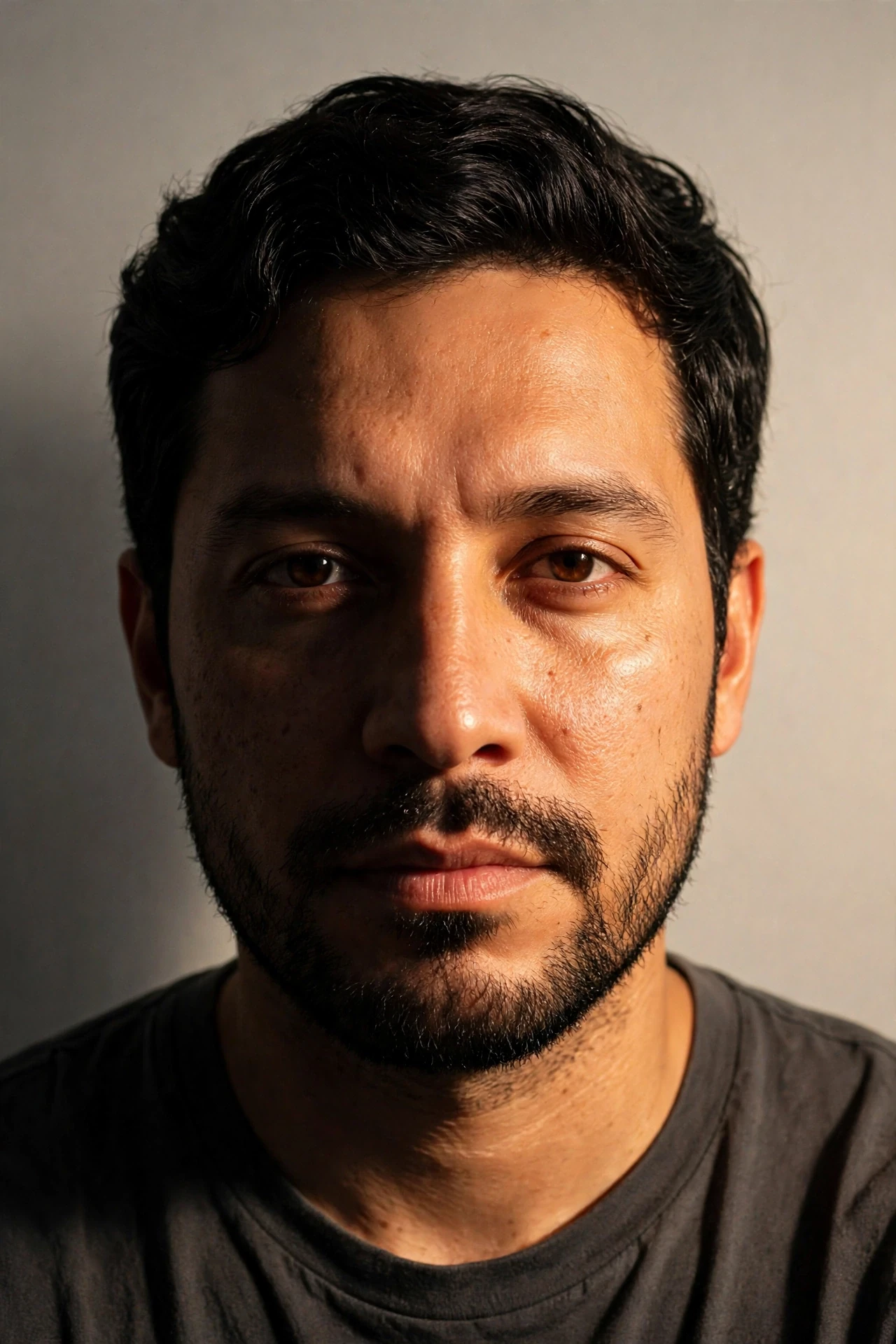
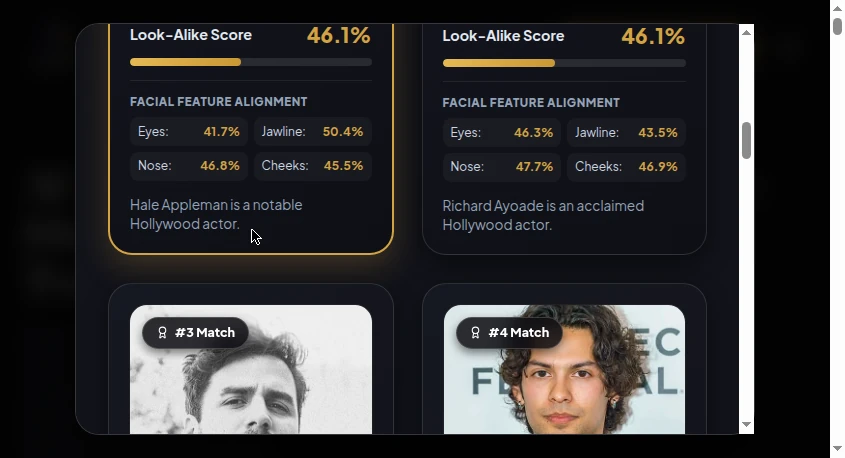
I know what you are thinking. Same man, and the top match flipped from TJ Martin to Hale Appleman at 46.1%. The score dropped more than 3 points, and Richard Ayoade tied for second at 46.1%.
So why does light do this? Think of it the way the tool sees your face. It does not see a person, it sees edges and contours: where your eye socket ends, where your nose bridge runs, where your jawline separates from your neck. Harsh side light paints thick shadows into those exact spots.
The shadow under the orbital ridge makes the eye area read deeper than it is. The shadow along the nose makes the bridge read wider. The jawline loses its clean edge where light falls off.
Look at the zone scores and you can watch it happen. In the soft daylight photo, the Eyes zone scored 50.9%. Under harsh side light, the Eyes zone for the new top match dropped to 41.7%. The shadow literally redrew the most measured part of the face.
Soft, even light shows the tool your real face. Harsh directional light shows it a face with painted-on shadows, and it matches those shadows.
Why Angles Change Your Celebrity Match
Photo three went back to soft daylight and a neutral expression. The only change: the head turned about 30 degrees to the side, a classic three-quarter pose. Here is the angled photo alongside the result:

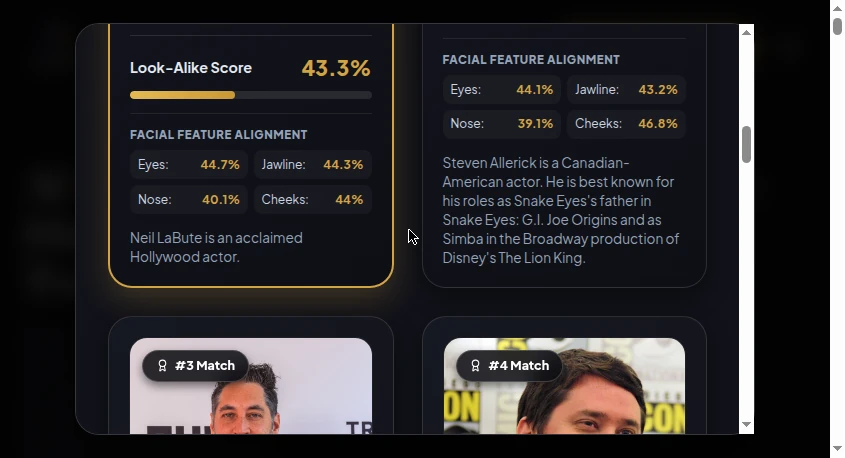
The top match changed again, this time to Neil LaBute at 43.3%, and the score fell to the lowest of all four tests. That 30-degree turn cost more than 6 points compared to the frontal baseline.
Here is the plain-English reason. When you turn your head, one side of your face compresses and the other side stretches, at least from the camera's point of view. Your actual bone structure did not move, but every distance the tool measures changed: the space between your eyes relative to your face width, the width of your cheekbones, the slope of your jawline.
The tool compares your photo against celebrity reference photos that are overwhelmingly frontal, so a turned head is asking it to compare two different geometries.
The Nose zone tells the story best here. It scored 49.6% in the frontal baseline and collapsed to 40.1% in the angled photo. From a three-quarter view, the nose simply presents a different shape to the camera, and the tool scores what it sees.
A turned head hands the tool squished proportions. It does its best, but it is matching a distorted map.
Why Facial Expressions Change Your Celebrity Match
This one surprised me the most. Photo four is frontal with soft daylight again, but the fictional man is now mid-laugh, with a big open-mouth grin and squinted eyes. Here is the smiling photo alongside the match:

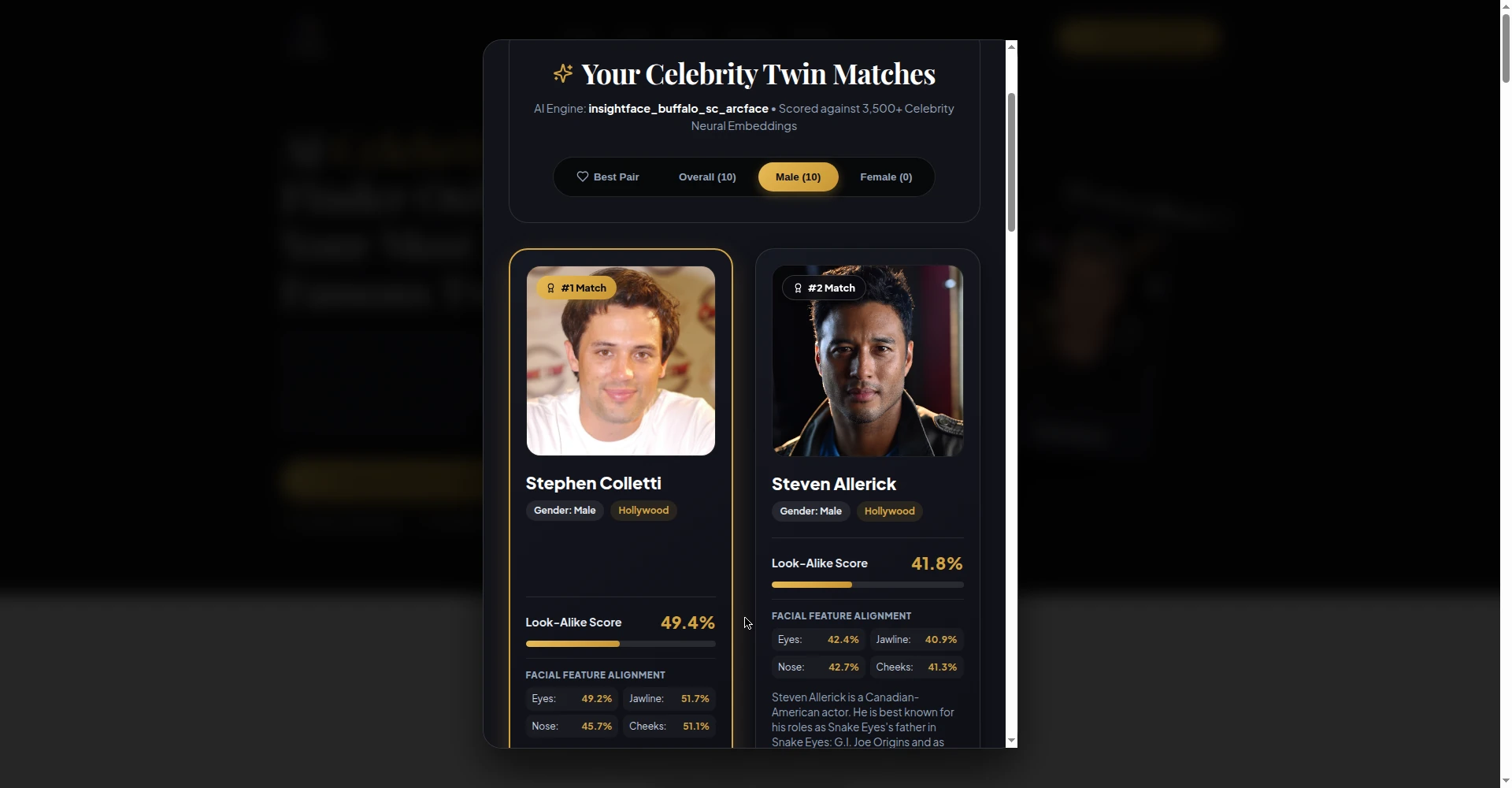
The score bounced right back up to 49.4%, nearly matching the baseline. But the winner changed completely, to Stephen Colletti. Same face, fourth photo, fourth different celebrity.
A smile is a full-face workout, and the tool measures the muscles, not just the bones. When you grin that wide, your mouth stretches up to a third wider than its resting width. Your cheeks lift and push your lower eyelids up, which narrows your eyes. Your jaw drops slightly, which lengthens the lower third of your face. Every one of those shifts moves the landmarks the tool is measuring.
And here is the funny detail the zone scores revealed. The smile photo produced the highest zone scores of the entire test: Jawline 51.7% and Cheeks 51.1% for the top match. Why did that happen? Because the celebrity reference photo it matched was also smiling. The tool found a celebrity whose happy face geometry lined up with a happy face photo.
Your expression does not break the match, it redirects it. A big grin matches you against the smiling versions of celebrities.
The One Signal You Can Actually Trust
Four photos, four different winners. So was the whole test just noise? Not quite, and this is the most useful takeaway in the post.
Look past the #1 spot and watch for the name that keeps showing up. Steven Allerick landed in the top 3 in three out of four scans:
The Steven Allerick Consistency Rule
No other celebrity appeared that consistently. Lighting changed, angle changed, expression changed, and Steven Allerick kept surviving the cut.
That is the real signal hiding inside noisy photos. When the same name keeps appearing across different photos of you, that is your genuine structural resemblance talking. One photo gives you a fun answer. Three or four photos pointing at the same person give you an honest one.
This is exactly why our homepage suggests trying 2 to 3 photos and comparing results. It is not filler advice. It is the single best trick in this whole guide.
How to Take the Perfect Match Photo: The 3-Rule Checklist
If you want the most honest match in a single upload, give the tool the cleanest map you can. Based on everything this test showed, the formula is simple:
Face a window in soft natural daylight
Stand facing a window during the day and let even light fall across your whole face. No lamps blasting from the side, no overhead ceiling light carving shadows under your eyes and nose. Even light preserves the real edges of your features, and the test showed it plainly: 49.7% in soft daylight vs 46.1% under harsh side light.
Look straight at the camera, lens at eye level
Think passport photo, not selfie angle. Keep your head level, do not tilt it, and hold the camera at your eye line rather than above or below your chin. A straight frontal shot keeps every proportion true, and the angled test proved the cost of turning: the lowest score of all four photos (43.3%).
Relax your face and close your lips
A calm, neutral expression preserves the true resting distances between your eyes, nose, and mouth. Save the big grin for the shareable result card afterward.
Final Thoughts on Your Celebrity Match
Your face did not change between these four photos. The light changed, the angle changed, and the smile changed, and the tool returned four different celebrities with scores swinging from 43.3% to 49.7%. The photo you upload matters as much as the face in it.
So here is my one-line summary of everything above: give the tool a soft daylight, straight-on, relaxed photo, and if you want extra confidence, upload two or three photos and look for the name that keeps coming back.
Try It Yourself: Find Your Celebrity Match
It is 100% free, there is no sign-up, and your photo is processed in temporary memory and never stored. See which celebrity your facial bone structure matches.
Upload Your Photo & Find Your MatchShare Your Result With Us
When you get your result, tell me: which celebrity did you match with, and did the same name show up in more than one photo? Drop your story via our contact link or share your result card. I read every single one.